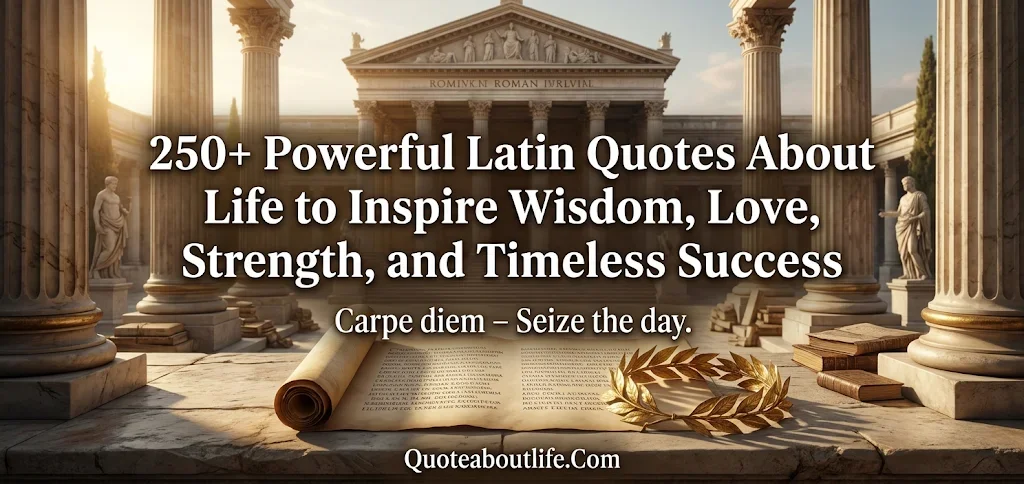
Few languages pack as much punch into so few words as Latin. For more than 2,000 years, Latin quotes about life from Horace, Virgil, Seneca, and Julius Caesar have shaped speeches, mottos, and tattoos.
This guide gives you 250+ powerful Latin quotes with English translations and sources. You will find inspirational Latin quotes for wisdom, love, strength, and timeless success. Quick answer to a common question: what does carpe diem mean? It means “seize the day.”
Table of Contents
Famous Latin Quotes About Life and Living Fully
These famous Latin phrases about life teach us to live in the present. Each one is short, sharp, and easy to remember.
Seize-the-day quotes
- Carpe diem – Seize the day (Horace)
- Carpe diem, quam minimum credula postero – Seize the day, trusting tomorrow as little as you can (Horace, Odes 1.11)
- Carpe noctem – Seize the night (modern)
- Carpe vitam – Seize life (modern)
- Carpe somnium – Seize the dream (modern)
- Memento vivere – Remember to live
- Dum vivimus, vivamus – While we live, let us live
- Vivamus atque amemus – Let us live and love (Catullus)
- Hodie mihi, cras tibi – Today me, tomorrow you
- Gaudeamus igitur – So let us rejoice (medieval student song)
- Nunc est bibendum – Now is the time to drink (Horace)
- Vive memor leti – Live mindful of death (Persius)
- Vive quasi cras moriturus, disce quasi semper victurus – Live as if you will die tomorrow, learn as if you will live forever (attrib. Isidore of Seville)
What does carpe diem really mean? It comes from Horace’s Odes, written around 23 BC (Britannica). Carpe means “pluck,” like picking ripe fruit. The film Dead Poets Society (1989) made the phrase famous in the USA. How do you say carpe diem? In classical style: KAR-peh DEE-em.
Hope and light quotes
- Dum spiro, spero – While I breathe, I hope (attrib. Cicero)
- Dum vita est, spes est – While there is life, there is hope
- Spes ultima dea – Hope is the last goddess
- Spero meliora – I hope for better things
- Vita est donum – Life is a gift
- Vita est pulchra – Life is beautiful
- Vita in motu – Life is in motion
- Fiat lux – Let there be light (Vulgate, Genesis 1:3)
- Lux in tenebris lucet – The light shines in the darkness (Vulgate, John 1:5)
- Ad meliora – Toward better things
- Semper ad meliora – Always toward better things
- Ad maiora – Toward greater things
Know-yourself quotes
- Sapere aude – Dare to know (Horace)
- Nosce te ipsum – Know yourself (Latin form of the Delphic maxim)
- Esse quam videri – To be rather than to seem (Cicero)
- Age quod agis – Do what you are doing
- Vincit qui se vincit – He conquers who conquers himself
- Mens sana in corpore sano – A healthy mind in a healthy body (Juvenal)
- Mens agitat molem – Mind moves matter (Virgil)
- Vivere est cogitare – To live is to think (Cicero)
- Scientia potentia est – Knowledge is power (Francis Bacon)
- Vita sine litteris mors est – Life without learning is death (Seneca)
- Non scholae sed vitae discimus – We learn not for school, but for life (Seneca)
- Docendo discimus – By teaching, we learn
- Ad fontes – To the sources
- Vitam impendere vero – To devote one’s life to truth (Juvenal)
Know-yourself quotes in context: Sapere aude became the slogan of the Enlightenment when Immanuel Kant used it in 1784. Nosce te ipsum echoes the maxim carved at the Temple of Apollo at Delphi.
Balance and well-lived quotes
- Aurea mediocritas – The golden mean (Horace)
- Aequam memento rebus in arduis servare mentem – Remember to keep a calm mind in hard times (Horace)
- In medio stat virtus – Virtue stands in the middle
- Festina lente – Make haste slowly (Augustus)
- Ne quid nimis – Nothing in excess (Terence)
- Est modus in rebus – There is a measure in all things (Horace)
- Utile dulci – The useful with the pleasant (Horace)
- Otium cum dignitate – Leisure with dignity (Cicero)
- Ars longa, vita brevis – Art is long, life is short (Hippocrates)
- Felix qui potuit rerum cognoscere causas – Happy is he who can know the causes of things (Virgil)
- Tempora mutantur, nos et mutamur in illis – Times change, and we change with them
- Quam bene vivas refert, non quam diu – It matters how well you live, not how long (Seneca)
- Veritas vos liberabit – The truth will set you free (Vulgate, John 8:32)
- Omnia mutantur – Everything changes (Ovid)
- Vita incerta, mors certa – Life is uncertain, death is certain
- Ex animo – From the heart
- Bona fide – In good faith
- Pax vobiscum – Peace be with you
- Ubi bene, ibi patria – Where it is well, there is home
- Vivere est vincere – To live is to conquer
- In vino veritas – In wine, there is truth (Pliny the Elder)
Latin wisdom reminds us to embrace life, pursue meaningful goals, and find strength through every challenge. For a more adventurous perspective on living authentically, explore these inspiring [Anthony Bourdain quotes about life and adventure], filled with lessons on courage, travel, food, and discovering the world.
Latin Quotes About Love and Strength
Romans prized two forces above all: love and courage. These Latin phrases about love and Latin quotes about strength still hit hard today.
Love and friendship quotes
- Amor vincit omnia – Love conquers all (Virgil)
- Omnia vincit amor, et nos cedamus amori – Love conquers all; let us yield to love (Virgil)
- Amor fati – Love of fate (Nietzsche)
- Si vis amari, ama – If you want to be loved, love (Seneca)
- Amor gignit amorem – Love begets love
- Ubi amor, ibi dolor – Where there is love, there is pain
- Verbis amor non eget – Love does not need words
- Amor est vitae essentia – Love is the essence of life
- Nihil sine amore – Nothing without love
- Fons vitae caritas – Love is the fountain of life
- Amor animi arbitrio sumitur, non ponitur – We choose to fall in love, not to fall out of it (Publilius Syrus)
- Amare et sapere vix deo conceditur – Even a god can hardly love and be wise (Publilius Syrus)
- Amor tussisque non celantur – Love and a cough cannot be hidden
- Amor et melle et felle est fecundissimus – Love is rich in both honey and venom (Plautus)
- Nunc scio quid sit amor – Now I know what love is (Virgil)
- Finis vitae sed non amoris – The end of life, but not of love
- Semper fidelis – Always faithful
- Ad vitam aeternam – To eternal life
- In perpetuum – Forever
- Amantes sunt amentes – Lovers are lunatics (Terence)
- Odi et amo – I hate and I love (Catullus)
- Amor omnibus idem – Love is the same for all (Virgil)
- Caritas patiens est – Love is patient (Vulgate, 1 Corinthians 13:4)
- Maior autem horum est caritas – The greatest of these is love (Vulgate, 1 Corinthians 13:13)
- Deus caritas est – God is love (Vulgate, 1 John 4:8)
- Cor ad cor loquitur – Heart speaks to heart (St. Francis de Sales)
- Pectus est quod disertos facit – It is the heart that makes us eloquent (Quintilian)
- Dilige et quod vis fac – Love, and do what you will (St. Augustine)
- Amicus est alter ipse – A friend is another self
- Amicitia nisi inter bonos esse non potest – Friendship can exist only among good people (Cicero)
- Ubi amici, ibi opes – Where there are friends, there is wealth (Plautus)
- Concordia parvae res crescunt – Small things grow through harmony (Sallust)
- Amicus certus in re incerta cernitur – A true friend is seen in uncertain times (Ennius)
- Vera amicitia sempiterna est – True friendship is everlasting (attrib. Cicero)
- Amor patriae – Love of country
- Vincit amor patriae – The love of country prevails (Virgil)
- Amicitia semper prodest, amor aliquando et nocet – Friendship always helps, love sometimes harms (Seneca)
- Nec sine te, nec tecum vivere possum – I can live neither without you nor with you (Ovid)
- Sunt lacrimae rerum – There are tears in things (Virgil)
- Amor ordinem nescit – Love knows no order (attrib. St. Jerome)
What is the Latin word for love? It is amor, and the verb is amare. What is the Latin word for strength? Virtus means courage and valor. Fortitudo means endurance. What is the Latin word for hope? Spes. For life? Vita. One tip: Virgil wrote Omnia vincit amor, but most people flip the order to Amor vincit omnia.
Courage and boldness quotes
- Audentes fortuna iuvat – Fortune favors the bold (Virgil)
- Fortes fortuna adiuvat – Fortune helps the brave (Terence)
- Tu ne cede malis, sed contra audentior ito – Do not yield to misfortune, but go more boldly against it (Virgil)
- Fortes creantur fortibus – The brave are born from the brave (Horace)
- Vires acquirit eundo – She gains strength as she goes (Virgil)
- Fata viam invenient – The fates will find a way (Virgil)
- Stat sua cuique dies – Each person’s day is fixed (Virgil)
- Fortuna caeca est – Fortune is blind (Cicero)
- Faber est suae quisque fortunae – Everyone is the maker of their own fortune (attrib. Sallust)
- Nil desperandum – Never despair (Horace)
- Noli timere – Do not be afraid (Vulgate)
- Sine metu – Without fear
- Invictus maneo – I remain unconquered
- Semper paratus – Always ready
- Nulli secundus – Second to none
- Non ducor, duco – I am not led; I lead
- Aut vincere aut mori – Conquer or die
- Si vis pacem, para bellum – If you want peace, prepare for war (Vegetius)
- Ex ungue leonem – You can tell the lion by its claw
- Dura lex, sed lex – The law is harsh, but it is the law
What does alea iacta est mean? It means “the die is cast.” Caesar said it as he crossed the Rubicon in 49 BC (Britannica). Today, “crossing the Rubicon” means passing the point of no return. Veni, vidi, vici followed his win at Zela in 47 BC.
Hardship and grit quotes
- Per aspera ad astra – Through hardships to the stars (attrib. Seneca)
- Per ardua ad astra – Through adversity to the stars (RAF motto)
- Sic itur ad astra – Thus one goes to the stars (Virgil)
- Per angusta ad augusta – Through difficulties to honors
- Fluctuat nec mergitur – Tossed by the waves, but never sunk (Paris)
- Luctor et emergo – I struggle and emerge (Zeeland)
- Veni, vidi, vici – I came, I saw, I conquered (Julius Caesar)
- Alea iacta est – The die is cast (Julius Caesar)
- Fortitudine vincimus – By endurance we conquer
- Fortitudo et spes – Strength and hope
- Virtus in arduis – Courage in hardship
- Fortis in arduis – Strong in difficulty
- Virtus tentamine gaudet – Strength rejoices in a challenge
- Virtus vincit invidiam – Virtue conquers envy
- Labor omnia vincit – Work conquers all (Virgil)
- Nihil difficile volenti – Nothing is difficult for the willing
- Gutta cavat lapidem – The drop hollows the stone (Ovid)
- Inveniam viam aut faciam – I shall find a way or make one (attrib. Hannibal)
- Sic parvis magna – Greatness from small beginnings (Sir Francis Drake)
- Vincit qui patitur – He who endures conquers
- Qui totum vult totum perdit – He who wants everything loses everything
- Adversa virtute repello – I repel adversity with courage
- Nulla dies sine linea – Not a day without a line (Pliny the Elder)
State mottos and American spirit quotes
- Excelsior – Ever upward (New York)
- Esto perpetua – May she endure forever (Idaho)
- Montani semper liberi – Mountaineers are always free (West Virginia)
- Alis volat propriis – She flies with her own wings (Oregon)
- Ense petit placidam sub libertate quietem – By the sword she seeks peaceful rest under liberty (Massachusetts)
- Qui transtulit sustinet – He who transplanted still sustains (Connecticut)
- Dirigo – I direct (Maine)
Kansas picked Ad astra per aspera, and Oklahoma chose Labor omnia vincit. Latin mottos are everywhere in the USA.
Are Latin quotes good for tattoos? Yes, if the grammar is right. Keep it to one to three words. Check the source in The Latin Library or the Perseus Digital Library. Skip machine translation and ask a Latin teacher. How do you say veni, vidi, vici? Classical: WEH-nee, WEE-dee, WEE-kee. Church style: VEH-nee, VEE-dee, VEE-chee.
While Latin wisdom offers timeless lessons about love, courage, and success, music can express life’s deepest emotions in equally powerful ways. Discover how Bob Marley’s inspiring words about love, peace, and freedom can bring positivity, hope, and happiness into everyday life.
Latin Quotes About Success, Time and Wisdom

Success takes effort, and time never waits. These Latin motivational quotes and timeless Latin proverbs give you wisdom for work, goals, and daily choices.
Work and learning quotes
- Acta non verba – Actions, not words
- Nil sine magno labore – Nothing without great labor (Horace)
- Labor ipse voluptas – Work itself is pleasure
- Ora et labora – Pray and work (Benedictine motto)
- Experientia docet – Experience teaches
- Usus est optimus magister – Practice is the best teacher
- Repetitio mater studiorum – Repetition is the mother of learning
- Qui quaerit invenit – He who seeks finds
- Quaerite et invenietis – Seek and you will find (Vulgate, Matthew 7:7)
- Primus inter pares – First among equals
- Magnum opus – A great work
- Ars gratia artis – Art for art’s sake
Honors and American motto quotes
- Summa cum laude – With highest praise
- Magna cum laude – With great praise
- Cum laude – With praise
- Veritas – Truth (Harvard)
- Lux et veritas – Light and truth (Yale)
- Dei sub numine viget – She flourishes under God’s power (Princeton)
- Novus ordo seclorum – A new order of the ages (Great Seal)
- Annuit coeptis – He approves our undertakings (Great Seal)
- E pluribus unum – Out of many, one (Great Seal)
- Pro bono publico – For the public good
- Citius, altius, fortius – Faster, higher, stronger (Olympic motto)
Three of these Latin phrases sit on the Great Seal of the United States.
Ambition and legacy quotes
- Ad astra – To the stars
- Nunc aut numquam – Now or never
- Hic et nunc – Here and now
- Dux femina facti – A woman was the leader of the deed (Virgil)
- Mens sibi conscia recti – A mind aware of its own rightness (Virgil)
- Integer vitae scelerisque purus – Upright in life and free of crime (Horace)
- Honor virtutis praemium – Honor is the reward of virtue
- Gloria virtutis umbra – Glory is the shadow of virtue
- Dimidium facti, qui coepit, habet – He who has begun has half done (Horace)
- Principium dimidium totius – The beginning is half of the whole
- Finis coronat opus – The end crowns the work
- Ab initio – From the beginning
- Exegi monumentum aere perennius – I have built a monument more lasting than bronze (Horace)
- Aere perennius – More lasting than bronze
- Si monumentum requiris, circumspice – If you seek his monument, look around (Christopher Wren, St. Paul’s Cathedral)
- Vestigia nulla retrorsum – No footsteps backward (Horace)
- Sapienti sat – Enough for the wise
- Dictum factum – No sooner said than done (Terence)
- Vincit omnia veritas – Truth conquers all
- Ubi concordia, ibi victoria – Where there is harmony, there is victory
- Aut Caesar aut nihil – Either Caesar or nothing
- Divide et impera – Divide and rule
- Ex libris – From the books of
- Semper idem – Always the same
- Incepto ne desistam – May I not shrink from my purpose
- Consilio et animis – By wisdom and courage
- Nulla tenaci invia est via – No road is impassable for the tenacious
Who built a monument of words? Horace did. His Odes ends with a boast that his poems will outlast bronze. Over two thousand years later, he is still being quoted. Wren’s son used a similar idea at St. Paul’s: the building itself is the memorial (Britannica).
Time and fate quotes
- Tempus fugit – Time flies
- Fugit inreparabile tempus – Time flees, never to return (Virgil)
- Tempus edax rerum – Time, devourer of all things (Ovid)
- Omnia vincit tempus – Time conquers all
- Eheu fugaces, Postume, Postume, labuntur anni – Alas, Postumus, the fleeting years slip by (Horace)
- Hora fugit – The hour flies
- Dies diem docet – Day teaches day (Publilius Syrus)
- Dum differtur, vita transcurrit – While we delay, life rushes past (Seneca)
- Omnem crede diem tibi diluxisse supremum – Believe that each day has dawned as your last (Horace)
- Tempus omnia revelat – Time reveals all things
- Memento mori – Remember that you will die
- Mors certa, hora incerta – Death is certain, its hour uncertain
- Mors omnibus communis – Death is common to all
- Mors ultima linea rerum est – Death is the final line of all things (Horace)
- Pallida mors aequo pulsat pede – Pale death knocks with an equal foot (Horace)
- Vulnerant omnes, ultima necat – All wound, the last one kills (sundial motto)
- Sic transit gloria mundi – Thus passes the glory of the world
- Respice post te, hominem te esse memento – Look behind you; remember you are only human
- Nemo ante mortem beatus – Call no one happy before death (Ovid)
- Non omnis moriar – Not all of me will die (Horace)
- Requiescat in pace – May he or she rest in peace
- Vita mutatur, non tollitur – Life is changed, not taken away
- De mortuis nil nisi bonum – Speak only good of the dead
- Post mortem nihil est, ipsaque mors nihil – After death there is nothing, and death itself is nothing (Seneca)
- Deus ex machina – A god from the machine
- Ave, Imperator, morituri te salutant – Hail, Emperor, those about to die salute you (Suetonius)
- Ubi sunt qui ante nos fuerunt – Where are those who came before us
- Nox est perpetua una dormienda – One endless night must be slept (Catullus)
- Ultima forsan – Perhaps the last (sundial motto)
- Sol omnibus lucet – The sun shines on everyone (Petronius)
What does memento mori mean? It means “remember you will die.” It is not gloomy. Stoics such as Seneca used it to push people to spend their days well (Britannica on Stoicism).
Wisdom and philosophy quotes
- Cogito, ergo sum – I think, therefore I am (Descartes)
- Errare humanum est – To err is human
- Errare humanum est, perseverare diabolicum – To err is human; to persist in error is devilish
- Ex nihilo nihil fit – Nothing comes from nothing (Lucretius)
- Homo homini lupus – Man is a wolf to man (Plautus)
- Panem et circenses – Bread and circuses (Juvenal)
- Amicus Plato, sed magis amica veritas – Plato is my friend, but truth is a better friend
- Quis custodiet ipsos custodes? – Who will guard the guards themselves? (Juvenal)
- Cui bono? – Who benefits? (Cicero)
- Audi alteram partem – Hear the other side
- Nemo mortalium omnibus horis sapit – No mortal is wise at every hour (Pliny the Elder)
- Nihil sub sole novum – Nothing new under the sun (Vulgate, Ecclesiastes 1:9)
- Dubium sapientiae initium – Doubt is the beginning of wisdom (attrib. Descartes)
- Nescit vox missa reverti – A word once sent cannot return (Horace)
- Verba volant, scripta manent – Spoken words fly away; written words remain
- Barba non facit philosophum – A beard does not make a philosopher
- Nemo dat quod non habet – No one gives what he does not have
- Post hoc, ergo propter hoc – After this, therefore because of this
- Reductio ad absurdum – Reduction to absurdity
- Quod erat demonstrandum – Which was to be proved
- Caveat emptor – Let the buyer beware
- Caveat lector – Let the reader beware
- Quo vadis? – Where are you going?
- Ignorantia legis non excusat – Ignorance of the law is no excuse
- Ad hominem – Against the person
- A priori – From what comes before
- A posteriori – From what comes after
Who said “I think, therefore I am”? René Descartes. He first wrote it in French in 1637 in Discourse on the Method. The Latin form came later. Likewise, errare humanum est is often credited to Seneca, yet it is an older proverb, and the second half is medieval.
Everyday Latin in English
- Status quo – The current state of things
- Alter ego – Another self
- Vice versa – The other way around
- Ad hoc – For this purpose
- Per se – In itself
- De facto – In fact
- Verbatim – Word for word
- Per capita – Per person
- Per annum – Per year
- In situ – In its original place
- Pro rata – In proportion
- Mea culpa – My fault
English borrowed heavily from Latin, both directly and through French (Britannica). That is why these phrases feel so familiar.
FAQs
What is the most famous Latin quote about life?
Carpe diem, “seize the day.” It comes from Horace’s Odes (about 23 BC). It urges you to enjoy today and not to rely on tomorrow.
How do you say “live life to the fullest” in Latin?
Classical Latin has no exact match. The closest options are Memento vivere (“remember to live”) and Carpe diem (“seize the day”). Dum vivimus, vivamus (“while we live, let us live”) also fits well.
What is a powerful Latin quote about strength and never giving up?
Nil desperandum, “never despair,” from Horace. Two more strong choices: Per aspera ad astra (“through hardships to the stars”) and Audentes fortuna iuvat (“fortune favors the bold”).
Are Latin quotes good for tattoos, and how do you pronounce them?
Yes, short Latin quotes make great tattoos. Check the grammar with a Latin teacher before inking. For pronunciation, classical Latin sounds v as “w,” so vici is WEE-kee. Church Latin says VEE-chee.
Conclusion
Latin quotes about life have outlived empires. They are short, honest, and useful. Save the lines you love, share them, and let timeless Latin wisdom guide your next big move.

Abroy Muzamil is a dedicated content writer who enjoys exploring words, meanings, and language. He aims to make information clear, useful, and easy to understand for readers. Through his writing, Abroy focuses on creating engaging, reader-friendly content that helps people discover the meanings of words, understand everyday expressions, and expand their vocabulary.